
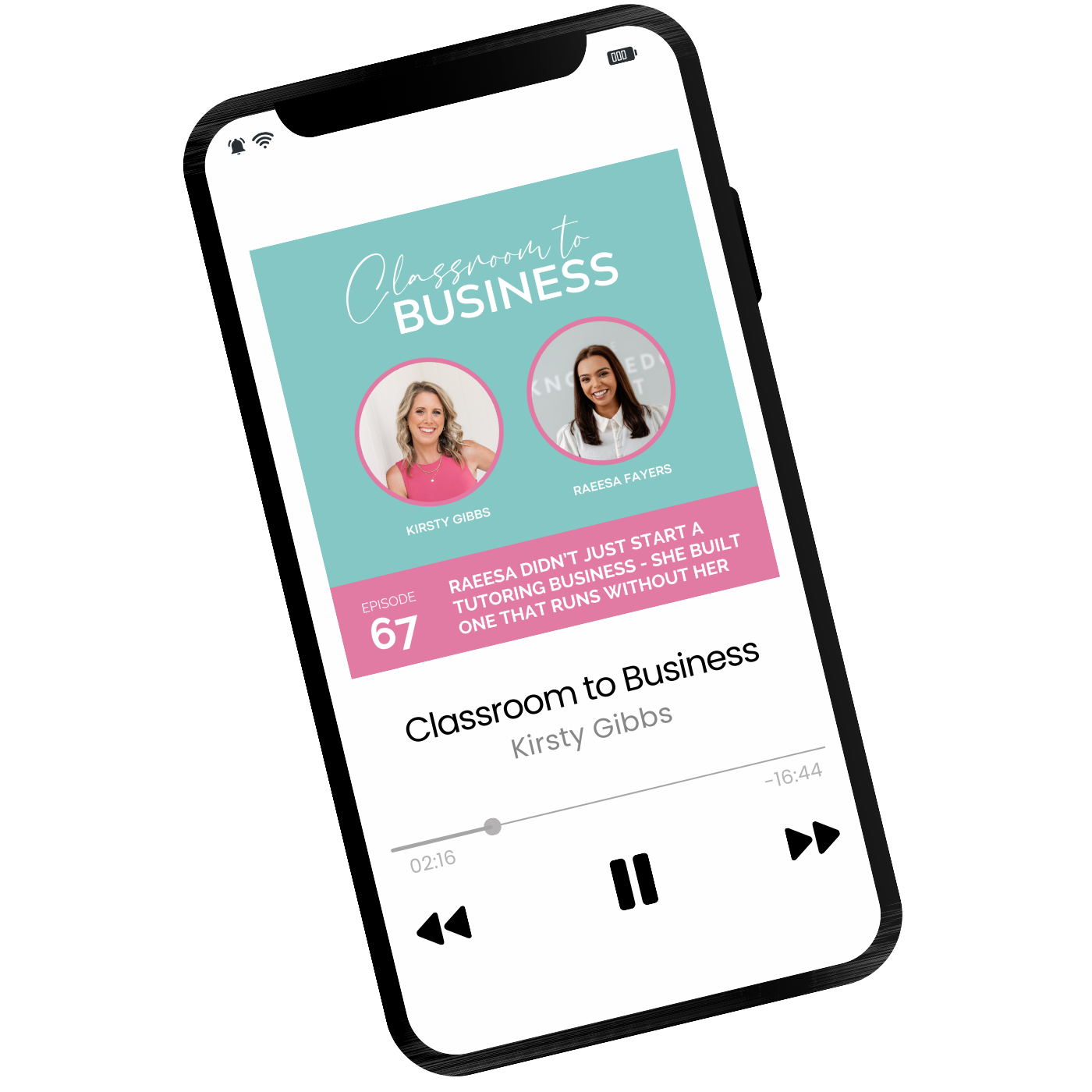
#67: Raeesa Didn’t Just Start a Tutoring Business - She Built One That Runs Without Her
She didn't just start a tutoring business, she built one that runs without her.
From garage tutoring to CEO, Raeesa shares what actually made the difference.
In this episode of Classroom to Business, I sit down with Raeesa Fayers, founder of The Knowledge Nest, to unpack how she went from tutoring in her garage to running a thriving business with hundreds of students and a team, in just two years.
We talk honestly about the mindset shifts, pricing decisions and systems that helped Raeesa stop trading hours for money and start building a business that runs without her.
If you're a tutor who loves teaching but feels stuck, overwhelmed, or capped by time, this episode is for you.
In this episode, we cover:
- Why one-on-one tutoring creates an income ceiling
- How group tutoring unlocked growth and profit
- The mindset shift from teacher to CEO
- Social media strategies that actually convert (without feeling salesy)
- Why systems, support, and mentorship matter more than hustle
Whether you're just starting out or ready to scale, this episode will help you rethink what's possible for your tutoring business.


Episode Transcription
Kirsty Gibbs:
Welcome to another episode of Classroom to Business. Today I'm super excited. This episode has been a long time coming because I am jumping on with a guest today, a previous client of mine, but the owner of an amazing tutoring business called the Knowledge Nest. So Raissa, welcome today. It is so wonderful to have you here and
I'm really glad that finally our timetable is aligned and we were able to hop on and do this call. Before we go any further, obviously I've got a lot to ask you about your business and how you got it to the point that you're at today. Can you just tell the listeners a little bit about yourself, your business and where you started because it's always really nice to hear the humble beginnings of what is now your successful tutor in business.
Raeesa Fayers:
Yeah, for sure. Thank you so much, Gesty. It's lovely being here today. So I first, I've been teaching over 10 years and towards the end of those 10 years, I went on MatLeave.
of MatLeave I was thinking to myself what could I do that I can still do what I love but have the flexibility to work and be at home and spend as much time as I can with my little one. For me it was the utmost importance to ensure that I
parent and I definitely didn't want to miss out on those early milestones as well. So when my little one was about six months old I had this idea to start a tutoring business. It just made sense to me because that would give me the flexible hours and also to work from home as well.
Raeesa Fayers:
So one of the services that we offer at the Knowledge Nest is school readiness and the reason why I wanted to start that sort of service in my tutoring, within my tutoring services is because
I have seen first hand how so many students who come into kindergarten struggle with basic skills, know, name writing, pasting a sheet into their work, you name it, like we've all been there as kindergarten teachers and just teachers in general and looking at my little one
Raeesa Fayers:
Becoming a mum had completely changed me because now, not only was I looking at it from a teacher's perspective, but from a parent's perspective as well. And I didn't want my little one going into kindergarten and having those same struggles and, you know, seeing and witnessing and being part of the frustration of the teacher at that time during class time. for me, it was like, why?
Don't we have a program out there that really, you know, prepares little ones for like the smallest things? You know, opening up their lunchbox, you know, recognising their name, especially in that first term of kindergarten.
And that's what sort of inspired me to start in the first place. When I first started, it would have been around to 2023. And it started off as Learn with Miss Fayez. That's what I called my hearing business.
Raeesa Fayers:
When we first started, I think about eight kids and those were referrals from the previous school that I had worked at. So parents who knew me at that point in time, was very much, you know, getting the word out there in terms of Miss Fayers is now doing tutoring. So that's how I my very first clients. But
The thing was, when I had those eight students, it was me and I was working eight hours during tutoring, as well as X amount of hours doing all the prep. So it was a lot of work back then, yeah.
Kirsty Gibbs:
very vividly remember your business in those stages. And I just want to ask you, I know that we haven't actually, I haven't prepped you for this particularly, but I'm throwing you onto the bus here because there were some points in time around then that you were questioning things a little bit. And I would say that
90 to 95 percent of people that I work with go through exactly that. They start this business and they have a few students but they don't know how to get more students. They don't know how to turn it into more than you know something that they're running from their own home and things like that. What for you, what helped you to keep going? Like why did you keep going as opposed to give up and go back to the classroom?
Raeesa Fayers:
think for me it was, yes I had the fear of, you know, what if this doesn't work out? I think everyone does at some stage.
Raeesa Fayers:
know, courage is when you feel the fear but do it anyways. And what kept me going is that I had a bigger vision for myself and what I wanted to get out of starting this business. Not only for, you know, to help children and support children and help them succeed, but I had a bigger goal in terms of the impact that I could make not just to those eight kids, but
you know, hopefully hundreds and thousands of kids. Well, we've reached hundreds, but thousands of kids. And not just in the space that we're currently working from, but across Australia as well. So that's the big vision. Yeah.
Kirsty Gibbs:
amazing. I love that. That's so good and I really hope there's a few ladies that I've been working with lately and I've got them in my mind as I'm asking you that question because they are at this stage where they've been going for you nowhere between three to six months and that momentum can be really slow to begin with and I keep saying them just keep going, just keep going. So it's inspiring to hear you say you've gone from that to having hundreds of students.
Those of you who are listening in that situation, I'm not just making it up. It is absolutely a thing. So what is something, a decision that you made early on in your business that maybe felt way too big or scary at the time, but you're glad that you did it anyway?
Raeesa Fayers:
Yeah, I remember working on this with you, Kirsty, in very beginning, in the early stages. There were two things. The first was raising my prices, which I think is a big thing for anybody because you have that thought, like, are people actually going to pay that much for these services? And it comes from a place of not really believing in yourself and what you have to offer. The other thing was
transitioning my students into groups. So when I started doing that and you know, we worked on that together, Kirsty, that was one of the turning points as well because it meant that I could support more students in less amount of time and it also meant more profit as well.
Kirsty Gibbs:
Did you, mean, again, a pain point for a lot of children business owners is we hit that income ceiling and we can't make any more money because we don't have any more hours in the day. And obviously looking at our prices and looking at the structure of the services that we offer and those margins, they're two key components there. For you, were there any hesitations from parents or even yourself?
going from one-on-ones to groups.
Raeesa Fayers:
for myself you know parents really emphasize on that one-on-one
assistance for their child and that one-on-one support. A lot of it was having those conversations with them and actually educating them on how groups could actually be beneficial.
for the child and how there's research that actually says that the collaboration and the peer feedback is important or just as important as one-on-one assistance. So for certain kids, if you know their personality and they thrive on competition, being part of a group is perfect for them. So I would just tailor that conversation based on what the parents were looking for.
and the child's personality as well. So that made it very easy to transition into groups. Those two things kind of work hand in hand, right? So you're trying to transition the kids into groups and then you're raising your prices as well. So your price structure is very important with that as well. So when we were working together, Kirsty, we spoke about
raising the one-on-one prices to a certain amount and keeping the groups at a certain amount. And then that also becomes a deciding factor for parents on whether they want to keep going with the one-on-one at a higher price or going into the groups.
Kirsty Gibbs:
almost makes it a bit of a no brainer then doesn't it? Because you've given parents the opportunity to, like you said, you've educated them on the benefits of groups and then you've given them this pricing structure that basically says, if you want this awesomeness of groups, it's only this price. If you want one on one, which is not even something that we highly recommend, you can have it, but it's at a premium price because maybe we have limited spots and things like that.
Raeesa Fayers:
Yeah, for sure. And it definitely makes parents say, yes, I want the one on one. And you see more value in the client in the type of clients that you get because they're willing to fork out that amount of money.
Kirsty Gibbs:
No, first of all, we're absolutely not.
Raeesa Fayers:
And then it also helps parents out in terms of, you know, if they're financially unable to do the one-on-one, then at least they are getting the support in some way through the group sessions at a lower price ticket.
Kirsty Gibbs:
Yeah. So was there ever a moment, whether it was around groups or pricing or just anything in your business where you thought this just isn't working, I need to change something? What triggered that and then what did you do next?
Raeesa Fayers:
So in terms of the one-on-one pricing, it isn't working.
Kirsty Gibbs:
Like they don't know where to go from here. Did you ever have any moments like that?
Raeesa Fayers:
Yeah, for sure. think definitely within the first year of starting the business, I was in my garage tutoring these kids and there's only so many hours in a week that you can tutor. So even with the group sessions and everything, you hit a wall. And then once you hit that wall, I think it's important to pivot and
then you start expanding your team. So I remember hiring my first tutor and that meant that she could take more one-on-one sessions and that meant I could.
you know, pass on some of my one-on-ones to her and implement more group sessions. And then it grew from having one to two to three and so on. And you just keep going and you keep building the momentum.
Kirsty Gibbs:
And I that's all the stuff we've got now.
Raeesa Fayers:
good question. I have about nine staff members, yeah, at this current point in time.
Kirsty Gibbs:
And let's recap, you only started two years ago, right?
Raeesa Fayers:
Yeah. Things grew very quickly.
Kirsty Gibbs:
Thank
Kirsty Gibbs:
They grow for a few reasons. They grow because there is a need for what we do. There are so many kids out there, right, who need that extra support. But also, your business grew because you did everything that we talked about. You you didn't keep coming back to me with excuses. You were like, okay, I hear what you're saying. And then you went and did it, like every single time. And I know there were moments where we would
jump on a call and I just pick up the vibe between our computer screens and I'm feeling a bit flat today. Things aren't going to plan and like you said, you're on Matleaf. So you were juggling, not just a business, but a baby as well. And yet you still kept at it. And that's what I love so much about working with people like yourself is like you said, Paul, you've got that.
bigger vision of where you want to go to and you don't let that slip away. You just keep doing the things that need to be done to get you there. it's no coincidence or accident that you've got your business to the point that it's got to today. It's you have worked for this and I think people do need to know that when you have a business there is a difference between having a business, sorry, you know, a side hustle.
that's five to 10 students and having a business where you've got hundreds of students and nine or so staff. They are very different things. And I'm looking at you right now and I mean, looks can be deceiving, but you look pretty calm. You look like you're organized and you've got it together. So it's not like a massive scary thing running a business of this size. And I think that's also really
cool for people to know as well that it doesn't mean your life will turn on its head just because you have a successful business or you have staff or you have more students. Actually growth is what we're trying to get out of our businesses. Sorry, that's just a little tangent there because I just think what you've done in the past two years is amazing and it's inspiring and it's to be congratulated and recognised because
Kirsty Gibbs:
It shows people what consistent work can do, but also consistent focus. You know, you never gave that up. All right, I have another question for you. So what's something that you see other tutors doing that makes you want to grab them and just give them a little gentle shake and say, please stop doing that and here's a better way.
Raeesa Fayers:
Yes.
Raeesa Fayers:
I think with this particular question, I'm going to talk about social media because I think that, you know, the tutors that are out there, they're doing their very best. They are doing what they know how to do and that is teach. So it's very natural for us to not...
Raeesa Fayers:
be as amazing on the business side of things and the marketing side of things, which is why I want to take this question in that direction. Because we all, you know, you're confident in your abilities, you know what you're doing when it comes to the teaching side of things, but how do we get more students? That's what we want to know, right? So.
Raeesa Fayers:
A lot of the times I notice that tutoring companies or you know, whether you're just starting out and I'm saying this with so much, you know, love and admiration because I did it too. Like, I'm not judging. I was there. I did exactly the same thing. So I can tell you that.
One of the things that we do, especially when it comes to marketing, is posting information or graphics that are basically teaching parents what to do. So people don't come to social media. We don't open up Instagram to be talked to. We don't come onto social media to learn.
Raeesa Fayers:
we want to be, we want to connect. That's the main reason. you know, sure, it looks nice and it fills up your feed to have those beautiful graphics that you've probably spent hours creating on Canva, but it's not converting to sales. You might get a few likes, but you're not
Raeesa Fayers:
speaking to the pain points of your audience and connecting with them. I think a better way to I guess market your business is through storytelling. That's something that has really worked well for me.
and really getting your audience to connect with you through that. And then you can have a CTA, a call to action, where you say, if this is how you're feeling, I was there to join our program as a sort of a call to action rather than just being the main thing.
Because people, we don't want to be sold to. We don't just post our offers all the time. We want to hear what's going on. We want to know you. We want to know what's going on behind the scenes as well and really making that connection with your audience because that's what gets them to buy.
Kirsty Gibbs:
Yeah, I love that. That's so good. And you just said storytelling and that's exactly it. You know, I think if most of us think about who we follow regularly and enjoy watching, it's not the person who's trying to sell to us all the time. It's the person who's entertaining us and connecting with us. So whilst we're on this topic, I'm gonna throw you some other questions. How often then...
you posting and creating reels and because I get it I get this question a lot do I need to post on social media now my answer always is you don't need to but you need to have a presence there as in it shouldn't be for a lot of businesses it won't be where they put all of their eggs they're going to be that and they're going to be doing advertising and marketing in other places as well especially you know word of mouth other collaborations
Kirsty Gibbs:
all those sorts of things. But it is so important to at least have a presence there. I know that you use your socials quite a bit for your marketing and advertising and there's a couple of other clients that do the same and they get fantastic results from it. Not everybody loves social media and so think a lot of people struggle with it. But for those who are listening who think yes,
I do love it, I want to spend the time and the energy and the effort there. Give me a little bit of an insight as to what it looks like for you, how often are you posting, what sort of things are you posting? they reels, carousels? Because I will put the link to your Instagram in our show notes, but in case people haven't seen it, tell us a little bit more about it.
Raeesa Fayers:
the frequency of which I bring on what my strategy is for that particular month. So if my goal is for people to get to know our tutoring center and to get more visibility, I would be posting every single day.
Kirsty Gibbs:
The frequency of which I...
Raeesa Fayers:
which is a lot, or at least five times a week, but that's because it suits that particular goal.
Whereas if I'm in maintenance period and let's say we're booked out and I still want to keep the consistency going, I would say at least posting three times a week. At the end of the day, it really doesn't matter how much you post, it's more about consistency. So the last thing that you want to do to your audience is completely ghost them. And I laugh because I am guilty of doing this.
Kirsty Gibbs:
Me too. Me too.
Raeesa Fayers:
What happens when you ghost your audience is you lose that momentum and then when you're like, hey guys, I'm back, then you find that your posts are getting lower reach because you've dropped off. So then you have to spend that time building the momentum again. So I think it's just important to make a choice about what suits you if you're able to do twice a week, if you're able to do three times a week and just stick to that.
Kirsty Gibbs:
advice and yes I'm with you there totally guilty of ghosting actually somebody messaged me it was a sales email you know saying I noticed you haven't posted on your Instagram in a while is there a reason for that I was like it's not my thing like in between BA's the moment don't ask me those card questions but what do you find at the moment and because
Kirsty Gibbs:
depending when somebody listens to this episode, might be different, but right now, the end of 2025, what are you finding is getting you good reach? So you talked about the storytelling, but is it carousels, reels, stories? What's working for you at the moment?
Raeesa Fayers:
think the combination of reels and carousels work really well. Carousels are doing really well right now. I think what is really important is the messaging that you use with whatever you're doing. Whether it is a reel, whether it's a carousel, talking to camera reels are doing really well at the moment.
Those are harder to film, unfortunately for us, but they do work because again, people, you know, want that connection. And with the carousel, if you post music in your carousel, it actually pops up in the reels.
section when you're searching Instagram. So there's a little tip there. So carousels also generally work very well because it's shown to your audience multiple times. So Instagram gives you a
couple of chances for them to see your carousel, whereas a real only gets shown once. So if you can use a combination of the two, that's amazing. Stories also works really well in terms of, you can poll your audience and do some market research.
you can post behind the scenes of your day. People are voyeuristic in nature and everyone really wants to know what you got up to over the weekend and that sort of thing or what coffee you like to drink. And stories is really good for sales and creating that urgency around what you have posted.
Kirsty Gibbs:
Love it. So basically now you're a social media guru, but your socials are amazing now and I know that I touched base with you a while ago and you know when we first saw that you're doing different things and we're talking about the traction and the last thing that I want to say here is what would you suggest for people see if it's working because I know that was one question I asked you. We look at likes and we look at how many people are following. Is there a way specifically that you're tracking how it's converting?
Raeesa Fayers:
Yes, so very early on in my journey I still struggle with that because I would say, that post didn't get many likes. You know it's easy for you to fall into that kind of mindset especially when you know that you've worked so hard on something. So for me to track it it's how many people are you know writing the keywords or DMing you the keywords that you put in your call to action. That's one way to gauge what's working and what's not.
Raeesa Fayers:
Yeah, yeah. The other thing is people are really honest with what you're putting out there. So you will get a lot of DMs from other businesses, parents saying, you know, how amazing they thought that post was, or you know that the actual post is converting. And even in your enrolment process as well, if you ask where someone has heard about you,
whether that's Facebook or Instagram or whatever it is, you can kind of track how many inquiries you're getting through social media as opposed to other forms of marketing.
And I have literally gotten parents through the consultation calls that we do say, you know that reel that you posted about the Kmart thing? That's exactly what I do. So you get people relating to your content as well, and they'll tell you about it. So I guess that's how I gauge whether something is successful or not, not necessarily based on the likes.
Kirsty Gibbs:
Yeah, it's very good. So we work together. So you took a step quite early on to engage in a business coach. A lot of people wait until they're more ready or they're earning. I don't know what the magic number is that people wait for. I don't know what the magic time is that people wait for, but I just feel like a lot of people wait.
before they sort of invest their time and their money and their energy. But you didn't wait. And so I'm curious, why didn't you wait? And then what shifted for you once you did start working with me?
Raeesa Fayers:
Yeah, I mean, that's a great question. And I think a lot of people are hesitant to have a mentor or a coach. And look, the thing is, at the end of the day, you can do it on your own. You can. But it's going to take you double the amount of time to get from point A to point B. Or you can invest in a mentor who's going to get you there in a shorter amount of time. And instead of learning and researching and doing all the things to find out what you need to do to be successful, you've got someone holding your hand.
Raeesa Fayers:
and leading you to the right direction of where you need to go in a shorter amount of time. So for me, it's a no brainer. You can spend two years learning how to, okay, maybe not two years, you can spend a year figuring out how to onboard clients successfully, or you can have a phone call with your mentor and find out how to do it in an hour. It's your choice.
Raeesa Fayers:
I love it. It does. It made it sound like a no-brainer. So was it something that you just knew when you were starting? Did you have like a specific problem that you were like, I need help with this? Or did you just think this is something I've never done before. I want to find out how to do it properly. Like what was your thinking?
Raeesa Fayers:
Yeah, no, it was definitely the latter where I said to my like, had the vision of what I wanted to do, but I'm a teacher. So I don't know anything about business and I'm not claiming to know everything about business. Even now there's so much to learn. But it was more so how do I get to the goal efficiently? Yeah.
Kirsty Gibbs:
Yeah. Love it. So obviously we work together, what shifted for you? Different people say there's different things, they get different benefits and you've talked obviously about the efficiency or the speed of getting results. Was there anything else specifically that shifted once you started actually learning how to do things in business?
Raeesa Fayers:
Yeah, definitely. mean, the first is having someone else that believes in you as well. You talk to family members and friends and they don't really understand because they've never had the experience of running a business and if so, even if they did have experience, a tutoring business at that. So you kind of get the, just go back to full-time teaching. It's probably not going to work. You you get the doubters and you know, having that mentor there for me really made me think like I can do this. I want to do this and I can do this and I will do this because I've got someone there alongside me.
Raeesa Fayers:
So yeah, I think in terms of what shifted, it's, I would say the belief in yourself. Like you already believe in yourself, but it's just having that sounding board, especially, you you might have a thousand ideas running through your head, but you really need someone to help you focus on certain goals and have a strategic plan set in place to actually get to those goals. Yeah.
Kirsty Gibbs:
So it's you've got the strategy on the how-to but also you're to believe in yourself that you can do it Perfect that's exactly what you want. Okay, so Let's be real though because it's not all unicorns and rainbows or rainbows and unicorns. Whatever way or something that you still struggle with even now and then
Kirsty Gibbs:
What's maybe helped you navigate that without burning out or hiding away from it, know, burying your head in the sand.
Raeesa Fayers:
my god, I could talk about this for days. One of the main things that I wouldn't say struggle with, but more so like things that I don't really want to do, if I'm being honest, is you know, the admin. my gosh, I don't think any teacher likes admin even when we're working full time.
Raeesa Fayers:
So, you know, organizing timetables that, I can't. You know, calling parents, organizing resources, the payroll, the invoicing, especially the invoicing. I want to rip my hair out every single week. You know, I love to just teach and mentor. Like that is what I want to do. So, what's...
Kirsty Gibbs:
Well, just to interrupt here, for anyone listening, I am actually working on creating a software that is going to do that for you. It is going to do your scheduling, your invoicing, contacting your parents, managing cancellations and payments, all that sort of stuff. I'll also put a link in the show notes. I wasn't intending to talk about it, but brought it up exactly for that because I felt the same as you when I started it.
Kirsty Gibbs:
my business as well. I I'm spending so much time doing this Yaki admin stuff. I want to teach. I want to be with my family, with my kids.
Raeesa Fayers:
Yeah, that's right. That's right. And it does eat up a lot of your time if you don't have those systems and processes in place. And that's exactly what helps me navigate it. So the first thing is outsourcing, know, investing in simple systems that lighten the load.
Our business has a few systems to make sure everything is running smoothly and things are taken care of without harvesting more time and energy. The other thing I think is really vital that's helped me navigate business and scale to the point where it has is hiring in an assistant that comes in a few times a week to print, laminate, organise, work on newsletters and any administrative
tasks. This is how I see it. Okay, so my time is valuable. If the task is not making me any money, it's not worth doing it myself. So I would rather work on tasks that will not only bring me joy, but allow me to focus on bringing in the cash flow. And I think this is where most tutors get stuck.
Kirsty Gibbs:
think you just hit the nail on the head as you're speaking. I'm just thinking we do, we get stuck in that cycle of being so busy and we don't ask for help or we don't realize that we can get help or we don't know how to get help or what to get help for or who could even help us. And so we just wear all of those hats. And it's funny, I've heard people brag about the fact that I saved.
Kirsty Gibbs:
you know, $20 by packaging it all myself. And like you in my head, thought, why the heck would I package that myself or do that myself when I can get someone to do it for $20 an hour, you know, $20 in total. It's, is such a different, we shouldn't be looking at our businesses as trying to save money. We should be looking at our businesses as how can we grow? How can we expand? How can we make more impact?
And to do that, you literally cannot save and cut your expenses. You actually need to invest more financially to be able to do that. And that could be a whole other topic for a podcast, but...
Raeesa Fayers:
my god, yes. So like I personally enjoy you know the laminating and the cutting and being creative but I would rather...
Offload those tasks and work on my social media strategy. Work on what I'm doing for the next six months. Work out a plan. Have a consultation call. Free up my time so that I'm bringing in money and in order to make money, you need to spend money.
So yeah, for me, it's a no-brainer. Like why would I sit there cutting out hundreds of cards or whatever it is that I need to, you know, that needs to be organised when I could be working on systems and other things to keep my business going.
Kirsty Gibbs:
just got goosebumps because you are literally stepping away from the teacher mode and you are going into CEO boss mode. That is the clear difference between yourself and other people who are still stuck in that I've got to do everything myself and I want to save money and I want to cut costs and I can't outsource and I can't get help. That is the difference.
As I think about everything that we've spoken about now, I do think that is why you've had such great success so quickly because you have just taken on and owned who you are in this new role. You're not just a teacher and I'm not saying there's anything wrong with being a teacher, I was a teacher myself, but that's not who you are in business. You are an owner, you are a manager, you are a director, you are the boss, you are the CEO.
when you step into that, you act like that and you get the results like that. So that is, I'm so excited for you. I cannot wait to see what the next, know, how far you've come in two years, what's going to happen in the next two years.
Raeesa Fayers:
Yeah, I can't wait either. Bring on 2020 stakes.
Kirsty Gibbs:
Well actually that brings me to my next question is that you have built a business that's you know got some good systems running now strong branding you've got clear offers what's something that's happening behind the scenes for you at the moment that you're working on what's next I know that I haven't prepped you for this question at all but what's something that you're hoping 2026 might bring for the Knowledge Nest?
Raeesa Fayers:
I think now I've reached a stage in my business where I'm like, okay, I can keep growing and expanding my team and that sort of thing. But now I'm working out a way without giving too much away to bring on the, there's a word for it, which I've kind of just lost in my head at the moment, but.
Raeesa Fayers:
having an income on repeat. that not just... Yes, like passive income. So working on something behind the scenes.
Kirsty Gibbs:
So I think more of a passive income.
Raeesa Fayers:
to bring in that passive income as well so that I can eventually not stop tutoring I wouldn't say that but you know work more so on the business side of things as well and I think the passive income is important because we do have holiday holidays and
you know, that could be a very stressful time for tutors because we don't always get paid in the holidays. mean, sure, you could have, you know, your holiday programs and things like that, but you need to rest as well. So, you know, creating that passive income is really important. So I will be working on.
something next year. We'll see how we go. I haven't fully put plans in place but I'd definitely love to keep you updated Kirsty.
Kirsty Gibbs:
So excited, I cannot wait. Very, very cool. And the thing is, I also love that you've got to this point before you've thought about that idea. Often people would jump in at the start and they say, I wanna do this and I wanna do this and I also wanna do a course and I wanna do a membership and I wanna make products. They might not say all of those things, but they've got at least got three of things going on that they want to do all at once.
Kirsty Gibbs:
but you have to do what you've done and get that first thing to a point where it's running quite smoothly. So if you stepped away, it would still run without you physically being there. It's making profits. It's doing a lot of things that needs to. And then you can look to what next. And I think that's a really important thing to remember is that one thing at a time, like we get this shiny object syndrome and we get so many ideas and they're all amazing.
but it's just not worthwhile trying to do more one thing at once.
Raeesa Fayers:
Yeah, for sure. I put my hand up. I was one of those. I can still be a bit like that to be honest. I love that man, my undiagnosed ADHD. But I just feel that we need to work up to a point where we're happy with the way.
everything is running and like you said what is really important is that you can build your business up to a point where it runs without you and that's something that I had experienced this year I you know got sick really randomly and was booked in for surgery and everything and I was freaking out
because I'm a bit of a control freak. So I was really freaking out like how's this gonna work? All those thoughts, all the things. And then what I realized is that they, my staff actually don't need me.
And that, that for me was my biggest achievement this year. They ran it so well. They fixed all the problems if there were any issues arising with the parents. Like, and that for me was an achievement that they actually don't need me to run. And I think that's what...
Kirsty Gibbs:
I love that. I love it so much. It's like at one point, it's like when your kids grow up, fine, you don't need me anymore, but also really proud that you don't need me. And that's what your business is like, your staff. That's so exciting. Like honestly, I think that's one of the best wins I've heard for this year so far. So congratulations. That is amazing.
Raeesa Fayers:
Yeah, yeah, no, for sure, for sure.
Kirsty Gibbs:
To finish up, I would like to say thank you firstly for coming on today. Like I said, we've stars aligned and we managed to get our timetables to make this happen because I've been wanting to get you onto the podcast for quite a while now.
The last question I have is what do you think actually separates those tutors who get stuck or stay stuck from the ones that grow into confident business owners? And then do you have any tips to give the people who are stuck before we finish up?
Raeesa Fayers:
my gosh, what a question. So I think what keeps us back is our mindset. I think that's a big one. Our brain doesn't know the difference between imagination and reality. So if you know, we've got that, that mindset of, you know, it's not going to work out, it's not going to happen, I won't be able to get this done. You know, we have these negative spirals that we go down every once in a while. It's very important to visualise where you want to be. And not only that, but I love just daydreaming about what life can be like and then going through all the five senses in terms of I'm already experiencing it. Like it's not something that's going to happen in the future, it's something that's happening right now. I did that a lot.
Kirsty Gibbs:
Yeah.
Raeesa Fayers:
especially at the start of the year where I, you know, imagined a premises and I imagined how it smelt, what the sunlight was like when it hit the room. Like I'm talking like extreme visualization and I would think about it quite often. And it's that quiet knowing that if you have that
thing in your heart that tells you like this is what I want out of my life that means that it's already yours. Right so when it came to my premises I remember saying to my husband he was looking around everywhere and I said to him there's only one place that I'm going to open up a centre, if ever I open up a centre. And that's going to be here at my specific location. And he said to me, well, that's a very hard place to get. Like as soon as it goes up for rent, you don't even know, like the next person just moves in. And I'm like, I don't care. That's my spot. That's my place.
And he said, all right, like, I'll do some cooling around for you. And in my head...
Kirsty Gibbs:
my goodness! Wow, All right, we're going to make another podcast episode on this and find out a little about, because this is fascinating.
Kirsty Gibbs:
So the thing that separates is mindset clearly because and aligns with what I said before you have stepped into that role because you believe this is who you are and I mean you hear you know very very experienced and amazing coaches say this all of the time that you have to step into the role that you are wanting to become and act like that person for that to happen. You know and I think this is just a one example or two examples of how that's come to fruition for you which is super super exciting. Thank you for sharing that. That is that is really cool. Very cool.
Kirsty Gibbs:
So true. What got you to this point now was X, Y and Z. And if you keep doing X, Y and Z, you still stay in this point. So to get to next point. To get to where you are, you've done X, Y and Z to get to this point. But if you're looking to get to that next stage up, X, Y and Z is not going to get you there. Whatever you've been doing still keeps you at that same point. Now you've got to do something completely different. And I think that is so where people, and you said it before,
you've got to lean into the fear, you know, you've got to be courageous and do the things that scared you to do the different things invest, take give that time all of that. So yeah, amazing. Hey, thank you for coming on again today once again, and it's just been so good to talk to you and hear about your success and hear what's been happening for your business. And I'm definitely going to want to get an update on 2026 and
and how that all unfolds for you.
COVID-19.
So good. And I'll put in the show notes the links to your website and your socials so people can follow along and see all of the awesome things that you're doing too.
