
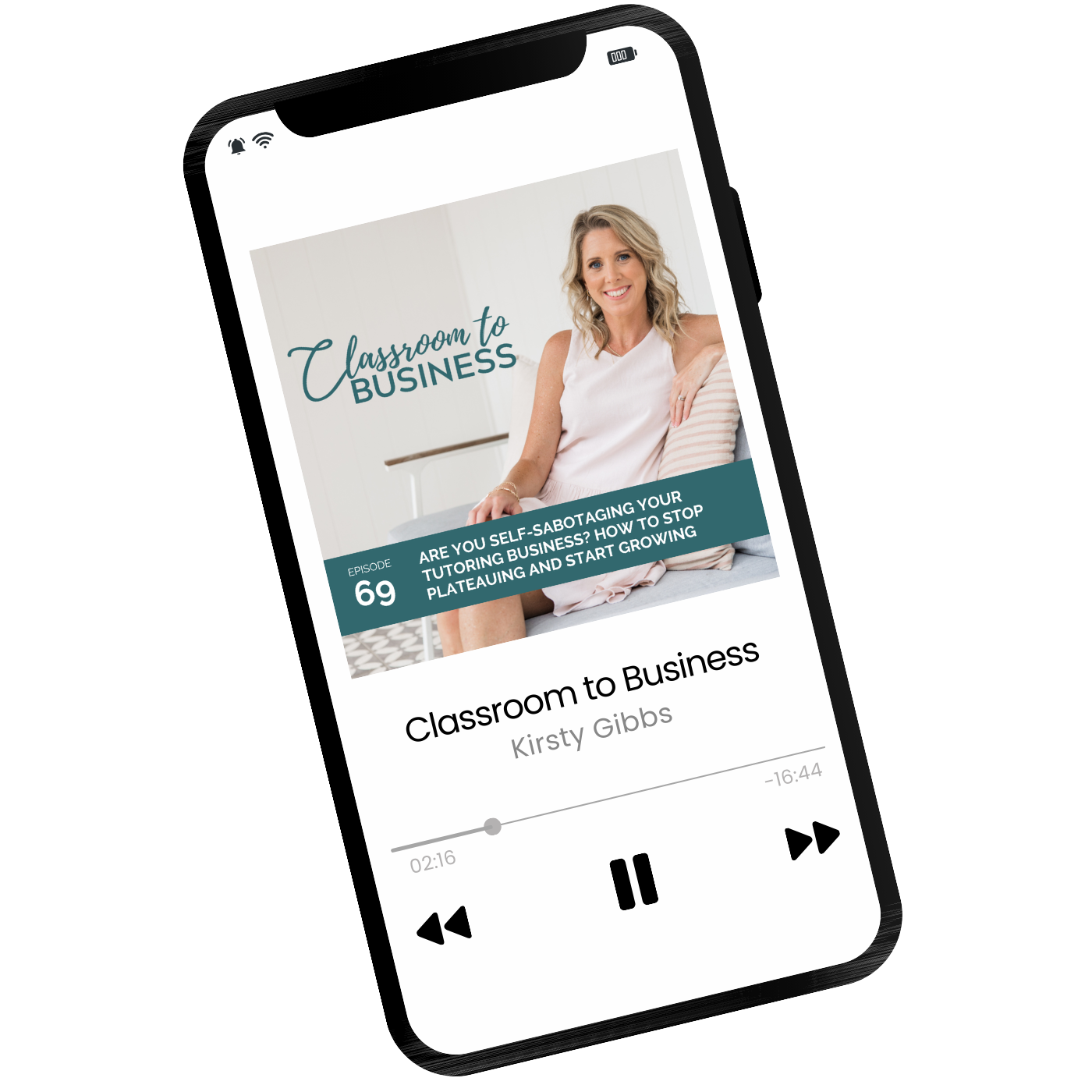
#69: Are You Self-Sabotaging Your Tutoring Business? How to Stop Plateauing and Start Growing
There comes a point in almost every tutoring business where the excitement fades and the overwhelm kicks in.
You’re emailing families late at night.
You’re chasing invoices.
You’re managing cancellations, complaints, staff, planning sessions, insurance…
And somehow you’re still expected to show up and teach brilliantly.
It’s a lot.
And if you’re feeling stuck, stagnant, overwhelmed, or quietly wondering why everyone else seems ahead of you — this episode is for you.
In today’s conversation, I speak openly about something we don’t talk about enough in business:
👉 We often become our own worst enemies.
👉 We subconsciously self-sabotage.
👉 We stay busy… but not strategic.
If you’ve ever felt like:
- Everyone else’s tutoring business looks more successful than yours
- You’re constantly running but not moving forward
- You’re distracted by new ideas and shiny opportunities
- You’re stuck paying yourself far less than you deserve
- You know you’re capable of more, but something is holding you back
You are not alone.
I break down the most common patterns she sees in tutoring businesses that plateau — and how to shift out of them.
In this episode, I talk about:
- Why comparison is killing your momentum
- The real reason you’re procrastinating
- Shiny object syndrome & the “parked for now” list
- Overworking isn’t the same as growing
- The vision → goals → tasks framework
- Why you must surround yourself with the right people
- The hard truth about income in tutoring businesses
Successful tutoring businesses are not built by people who have more time, more energy, or less fear.
They’re built by people who:
- Stop making excuses.
- Invest in their growth.
- Take their business seriously.
- Lean into discomfort.
- Do the thing — even when it feels scary.
You’re not “just” a tutor. You’re a business owner.
And if you want your business to grow, scale, and truly support your family financially, you have to show up as the CEO — not just the teacher.
If this episode hit a little close to home and you’re ready to stop plateauing…
🎟 Join us at Tutors Day Out. Secure your spot here.
Spend a full day surrounded by passionate, growth-focused tutoring business owners who are committed to doing the work — not making excuses.
This is not networking.
It’s not surface-level. It’s real conversations, practical strategies, and serious business growth.
And if you’re listening and thinking, “I know I need help getting this to stick” — reach out. This is exactly what I help my clients with inside my programs.
Because your tutoring business deserves more than burnout and busy work.
It deserves growth.


Episode Transcription
We often in business become our own worst enemies and we subconsciously self-sabotage. We do such a disservice to our own businesses because of the way that we think and some of our actions.
And I wanted to help you nip that in the bud because our industry is a growing industry. There are so many families and students who need your support.
There is enough room for everybody to be successful within their own niche, using their own superpower, their approach, whatever angle you want to put on it here.
You can be successful, but not everybody will be successful. And so today I wanted to share some things with you that I think you can take and implement into your business and maybe some things to avoid so that you can take your business from plateau.
So one of the things that I find is a lot of people start their businesses and they're extremely passionate.
And I was the same. I was very excited to start my business and I loved it very, very much.
But it gets to a point where it becomes hard. There is so much to do. There is honestly so much.
You're emailing families back late at night. You're following up invoices. You're creating invoices. You're following up payments. You're looking into insurances.
You're trying to hire staff members. You're planning for sessions. Maybe now you're following up staff members because there were issues or complaints or cancellations.
That's like a snippet of the amount of work that you have to do. And I know this because I was in your position.
I had tutoring businesses of my own in two different locations with lots of staff, lots of people to manage, lots of moving parts.
It is a lot. Now, I know not everyone has got a business like that. I know not everybody wants a business like that.
And the way that I just sold that then, who would, right? But that is not how you necessarily, that's not the end goal, okay?
We have these stages of business that are a little messy, a little intense, a little overwhelming. And like I say, business is like a roller coaster.
And it's not straight highs and straight lows. Sometimes you can be on a high for quite a while, and sometimes you can be stuck in the lows for quite a while.
But what I wanted to share with you today were some strategies and some things that you can implement so that when you're in those lows to help you get out, and when you're in those highs to potentially help you stay there longer.
One of the biggest, oh, actually, there's a few things and I wanted to touch on all of them. The things that I see as common patterns happening in businesses where they're...
They're stagnant. They're overwhelmed. They're feeling like they're running a race against other businesses. They're feeling like they're competing against other people.
They feel like everybody else is ahead of me and I can't keep up. If you're feeling that, if you're thinking that, then this is exactly the episode for you.
Firstly, I want to say what you see on social media is not the be all and end all of every single person's business.
And that's across the board in every single industry. So please keep in mind that when you see somebody looking like they're doing amazing, I mean, they very well might be, but you don't know all of the behind the scenes of what's happening there.
Right? So that's the first thing to keep in mind. Secondly, you are running your own race. You do not need to compare to anybody else.
Don't compare your business. Don't compare your profits, your revenue. Obviously, these things are good to know because it helps to give you a basis.
And I talk about comparing prices. I talk about looking what else is out there in the market, what's happening.
But it's to understand your industry. It's not specifically to sit there and compare where you are in your journey because everybody started at a different time.
Everybody comes in with different backgrounds. It's like when we look at our kids in the classroom, especially in that first year of school, they are all at different stages, okay?
And they've all come with different background knowledge, different skills, and different abilities. It's the same in business. The difference is we're not going through 13 years of education where we're trying to hit certain goals.
We all have our own different unique goals that we're trying to achieve and different visions. And so our paths and journeys will be completely different.
So please remember that. Now, some of the big challenges that a lot of us face, and I say us because I...
I definitely faced these when I had my own tutoring business. And if I'm being really honest with you, I still face them sometimes now.
The first one is procrastination. Often we will procrastinate because of a fear. And sometimes that fear isn't actually doing the thing.
Sometimes the fear is the result of doing the thing. So you have to figure out why you are procrastinating with something.
If you've had something on your task list or if you've had something that you just have not been able to shake and get off your calendar, it's been on there for weeks or months or however long, why?
Why is it still sitting there? Sometimes we'll procrastinate because we're scared of doing the thing. So I know that a lot of people will procrastinate with social media because they're scared of putting their faces in front of the camera.
And I get that. It is a scary thing, right? It's something that a lot of us aren't used to.
We haven't done it before, but we procrastinate in doing it and then it doesn't happen and that directly impacts our goals.
Okay, I'm going to touch on this a little bit later, but you have to think about when you procrastinate, what is the outcome of that?
Now, so like I said, remember there's a couple of different ways procrastination can impact us. And it is sometimes we procrastinate because we're scared of doing the thing, but sometimes it's because we're scared of the outcome.
So if we look at it from a different angle and we say, okay, maybe I'm scared to do something because of how somebody is going to take that.
So for example, I might want to be on a podcast. Let's just say I want to be a guest on a podcast.
And, you know, for those of you listening, it might be something that you're interested in. And that's been on my list to do.
Whatever. Like, get on this particular podcast. Ask this person to be on their podcast. I'm procrastinating. And when I think about it, I think this would be a great experience.
I would get in front of my audience. So many parents would hear me. It would be great. Blah, blah, blah.
But why am I not doing it? I'm actually not doing it because I'm scared that if I reach out to that person, they might say no.
And maybe I don't want be rejected. Or maybe I am just so nervous about losing the potential opportunity to get on to the podcast episode that I don't even do it.
So this could be quite deep for you here, guys. So take some time to think about this. And even if you're listening to this, pause it if you need to.
What are you procrastinating about? And why? Is it because you're scared of actually doing the thing right now? Or maybe are you scared of what that outcome might be?
And I mean, I know other... Businesses are scared of growth, and it sounds weird, but they might be doing really well in their business right now, and they might be looking at opening a second centre, but they're scared of the impact of what that will have on their family life or their free time.
And this is not here to say right or wrong, but if they're your goals, if that's what you're working towards, then procrastination is stopping you from getting there.
Okay, so that's a big one. Now, I'm not going to go into everything today, just the main ones that I'm seeing popping up a lot lately.
Okay, so first one, procrastination. Figure out why you're procrastinating. Another one is distraction. Now, this is the whole shiny object syndrome, and I am working very, very hard myself on this.
So when I say, I understand you, you can trust me 1,000%. I understand you. I get you. Because there are so many things that we want to do.
And... There are so many great ideas out there and they keep coming at you. You just don't know where to start and you don't know what to do next.
So a little tip, if you haven't heard me say this before, start a Parked For Now list. Any ideas that come in, park them.
Do not do them right now. Now, I'm going to give you some more action steps after this soon. This is actually a really great episode to save, by the way, because it is quite practical.
But when you are distracted, it's taking you away from what actually needs to happen. And often in business, we become so distracted with all of these things.
And usually they're things that we see on social media or we hear other people talking about and think, oh, that sounds great.
Oh, I haven't done that in my business. Oh, that would be really good. We get taken away off our own path and we start doing things that are actually not truly aligned with our immediate.
Like I said, I'm going to give you some strategies on how to avoid this soon. So that's our second one, distracted.
It kind of ties in with my next one of focusing on the wrong things. And that does usually come from distraction, listening to lots of other people, and not backing yourself, not believing in yourself, not going, okay, head down, bum up.
This is what I'm doing. That's a great idea. Thanks, park to list. That's a great idea. Thanks, park to list.
You don't take that in. You have like a sieve, right, and nothing else is getting in to your world unless it is exactly aligned with what you are doing and the goals that you're currently chasing.
So when we focus on the wrong things, it often keeps us really busy, and it can often lead to my next one, which is overworking.
Overworking. Overworking. Overworking. Overworking. next Fathom a, it ties in with all of these, to be honest. And I think we do it because we think that when we're busy, sorry, when we're successful, we need to be busy.
We need to be working long hours. We need to be doing lots of things. And we find it difficult to switch off.
We find it difficult. And I know we've just had this chat with some of my members in the Profit Pathway the last few days.
Some of them have actually got staff members in, the afternoon. And I've started feeling guilty about leaving their, their work premises and having staff take over.
And again, I know that I get that because I felt the same way. But the thing is, you can't be overworking yourself.
You can't be burning yourself out. You are the owner of your business. You're not there to do all of the nitty gritty in, you know, day in, day out tasks of your business.
You're there to oversee it. And, you're It's an excuse. If you say to me, I can't do this. I don't want to do this.
I can't. There are excuses. There are reasons why. Okay. Within reason, you know what I'm saying. I'm sure right now that if you came to me with some of the things that you'd been wanting to do for a while that haven't happened or some of the challenges you're having in your business, if we sat down and had a serious, proper, realistic conversation, you would own.
Yep. I'm making an excuse as to why I'm not doing that. There's a reason why. I'm scared to do that because I think this is going to happen.
Or I'm scared to do that because I don't like what my face looks like on the camera or what my voice sounds like.
By the way, I hate what my voice sounds like. And I record podcasts. I just don't ever listen back to them because I don't like it.
So if you don't like looking back at the videos of yourself, don't do it. But excuses are what? Sums up all of these things, and it's exactly what will keep you stuck.
So things that you can do in your business to help keep you on track and help you to avoid making these excuses and procrastinating and getting distracted and overworking and focusing on the wrong things.
Some of these you would have heard me talk about before, and some of these seem really obvious. And maybe that's why we don't do them, because they're that obvious that we just think, oh, that's simple.
I don't need to do that. No, guys, you need to do this. So come back. Set your vision. What is the vision for your business for five years, for 10 years?
Where do you want your business to go? This is not a be-all and end-all. This is an opportunity for you to think.
About students, enrolment numbers, it's an overview, okay? Now, a lot of people have vision boards, and these can be really powerful for a lot of people.
And everybody, to be honest, everybody who I've spoken to who has a physical vision board seems to do really, really well with their vision.
So that might be saying something. Like, even myself, when I sit there at the end of every year and write out my vision for three, five, ten years' time, I don't have it as a physical board in my house, even though I'd love to do that.
Maybe I should do that. But I have that as my guide as to where I'm going. And I won't just talk about my business.
I will think about my family, what I'm doing with my kids, holidays I want to go on, travel I want to go on, and the number of times that I can look at my vision board and go, wow, five years.
I said this year I want to be doing this, and that's exactly what's happening, is mind-blowing. But you've got to put it out there, okay?
You've got to put it out there as that little pin on your map and your GPS to go so you know where you are going.
All right, so I won't keep going on about that. Vision. If you don't have a vision, you need to spend some time thinking about it, figuring it out, and just mapping it down.
From your vision, then you set goals. Again, it's one of those things that we think, oh, my gosh, everyone talks about goals.
It's so easy. I don't need to do them. Yeah, I hear you, okay? And there's been plenty of times where I haven't set goals.
Every time I set goals, I'm so much more productive. I'm so much more focused. I do not procrastinate anywhere near as much because, this is the key point now, from your goals, you break that down into tasks.
strong. rasa own time. We'll see This is the key thing that will keep you on track because they are your tasks for your business, for your goals.
Nobody else. So it doesn't matter what else you see out there, what else people say to you. That's a great idea.
Thanks. Put it on your parked for now list. But if it doesn't align with your goals and your tasks that you're doing right now, it is taking you off your path.
It is giving you a detour on your little Google Maps drive. You do not want that because it leads to overwhelm.
It leads to your procrastinating of doing what you actually need to do. It leads to you getting distracted, burnout, focusing on the wrong things, all of those things.
Can you see how it all kind of comes together? So your goals are important because they anchor you into your vision.
And then it allows you to say, this is my goal. These are the tasks that I need to do to get me to my goal, by the way.
If this is new to you, if you haven't done anything like this before, reach out. This is exactly what I help my clients with.
And maybe if you have done it before, but you just can't get it to stick, please also reach out because I'd love to help you.
So we've got our vision, we've got our goals, we've broken it down into action tasks. And now we want to allocate time.
Because just having a big list of tasks isn't always helpful if we feel like we can't get it done.
So these next two, allocate time and outsource or delegate, these kind of go together. And this is something that I will be speaking a lot to at Tudor's Day Out, is how you manage your time effectively and how you become the CEO or the boss of your business.
It is something you... It is a leveled up version of yourself. Whatever you've been doing for the past five months, five years, whatever it is to get to where you are now, has been most likely employee mode.
It's been hustle mode. It's been winging it mode. It hasn't been the version of you or the mode of you or the actions that are going to take you into boss mode, CEO mode, you know, having a Having business that is running like a well-oiled machine, having a business that you can step back from when and if you need, having a business that has employees, having a business that pays you more than $300 to $500 a week.
All right. That's just fact. You have to change what you're doing along the way. And it is usually quite a big change.
And if I'm being really honest, it's often one of those examples where it's you take a step back to take a step forward.
So I won't go into that. too much today, but those are things you also need to consider. Allocating your time.
So making sure those tasks are put into your calendar. And this is like weirdly something that I love doing and love helping other people with.
So like I said, if you find this a challenge, let me know. And then outsourcing, automating, delegating, stepping into that CEO role where you aren't doing all of the things in your business anymore.
So they're the things that you need to be doing in your business. Oh, and there's two others, actually, I lied.
You need to surround yourself with the right people. And this is just in life, I feel. You know, they do say that you are, I'm going to get this saying wrong, but you know what I mean?
You're the sum of the five people that you spend the most time with. That one there. If you're spending your time with people who to It's and to you,
Who love business, who are passionate about business, who are thinking growth strategies, you know, who are excited, that lifts you up, that immediately lifts you up, it changes your mood, it changes your mindset, it gives you bigger dreams, it gives you big hope, inspiration, motivation, all of those things, as opposed to someone who's maybe no idea about business and you can't have a conversation with because, you know, even though they mean well, they can't bounce ideas around with you.
They can't tell you, oh, this worked really well for me, or definitely don't do this because I, you know, lost so much time or money or whatever, it just did not work.
You want to be surrounded by the right people. And yes, I am going to take a moment here to plug Tudor's Day out because it is a perfect example of that.
It is a day where we are coming together as a group of passion. It's really inspiring for you to see, wow, this is a real thing.
It can actually happen or, oh, my goodness, look at the result they did. That's definitely not something I want to do.
Thank you so much for sharing that. Okay, so asking questions from people who are in your industry. Those are the key things that I would say to do if you do not want to stay where you are now.
So, obviously, we touched on this before, but the cost of not doing these things, it's staying where you are.
It's plateauing. It's not even paying yourself $300 to $500 a week in your tutoring business. And if you hear me say that and you think, oh, I'm only paying myself $300 to $500 a week or even less, then when I say that, I say that because I know that it can be more and I know that for the amount of time...
The that you work in and on your business, you are worth more and you deserve more. I'm not going to tell you that that happens in the first 12 months because I do not speak BS to you.
I will speak the truth to you. I will be real and honest. But if you've been in business for a few years, then that's definitely something that you should be looking at.
A lot of people, again, make excuses for why they're only earning that amount of money or they make excuses for why it's okay.
Oh, you know, my husband, and again, this isn't me, this is, say it with love, but think about what you're doing, you're self-sabotaging because you're saying things like, I'm on maternity leave, I don't need to worry about money, or my partner is paying, you know, my husband has a good wage, so, you know, we don't need to worry too much.
No, guys, if that's your attitude, then you have, you should be looking to create a... If you're wanting to create a business that grows, that scales, that helps more people, that gives you financial freedom to support your own family, then you have to be thinking, what do I need to do in my business to reach my goals?
That is what you have to focus on. That's the question every single day to say to yourself, what do I need to do today in my business, on my business, to get me to my goals and my business?
My path, my journey, I'm not getting off this train for anybody else, I'm not stopping at any other stops, it's just my path, my journey.
So, like I said, we don't want to plateau, we don't want to be paying ourselves. We don't want to be going back to the classroom.
That's the other risk we... But I want to be real with you. Flipping around, though, there is a silver lining here.
And that is prevalent in all successful businesses out there. It is proof. If you go out and you listen to some of the other episodes that I've spoken to with other business owners, you speak to some of the clients that I work with, the difference is the identity of people who show up.
They do not make excuses. Now, these people aren't less busy. They don't magically have more time. They're not less tired.
But what they do is they take their business seriously. They do not treat it like a little thing on the side.
They do not just focus on teaching. They do not spend all of their money on PD and... Resources. They do not think, I just need to do one more course so that I'm trained in X, Y, and Z, so that I can put that on my website.
No. They know that their business is part the service that they deliver, part marketing, part admin, part CEO. There are all of these different components that make up their business, and they take every single one of those sections seriously.
They know that growth requires investment, and then investment requires discomfort, and discomfort creates growth. It creates expansion. When we step into that zone where we're uncomfortable, where we're doing those things that we've put off, that we're fearful of, that we've procrastinated on, that's when the magic happens.
That's when we see the changes. Thank And that's when we see the growth. So you need to move into this.
You need to stop with the excuses. Take your business seriously. Get in a space, like I said, Tudor's Day Out, perfect opportunity for you to take this first step to do something.
If you've never, ever invested on your business growth, or maybe you've invested but you know you need to do more, the Tudor's Day Out is the perfect opportunity for you to do that because it's not a long-term commitment.
It's very great value. It's not extremely expensive at all. And you are going to be in a room full of people who are just like you, doing what you do, who are passionate about working with children, but also passionate about growing a successful business.
The people in this room are not the people making excuses. The people in this room are the people taking their businesses seriously.
They're doing the work. They're doing the right work. They're parking the distractions. All of those shiny objects that we all see, they're saying, wow, that looks amazing, but I'm not going to do that just yet.
They are capable just like you are. But the difference between them and somebody who doesn't succeed is that they are doing the thing.
Okay, so if you want to get yourself in a room like this, then please head to the link. I'll put it in the show notes.
If you have any questions, let me know. But remember, when you have a tutoring business, you aren't just a tutor.
You aren't just a teacher, an educator. You're a business owner. And so right now, if you feel like you need...
